

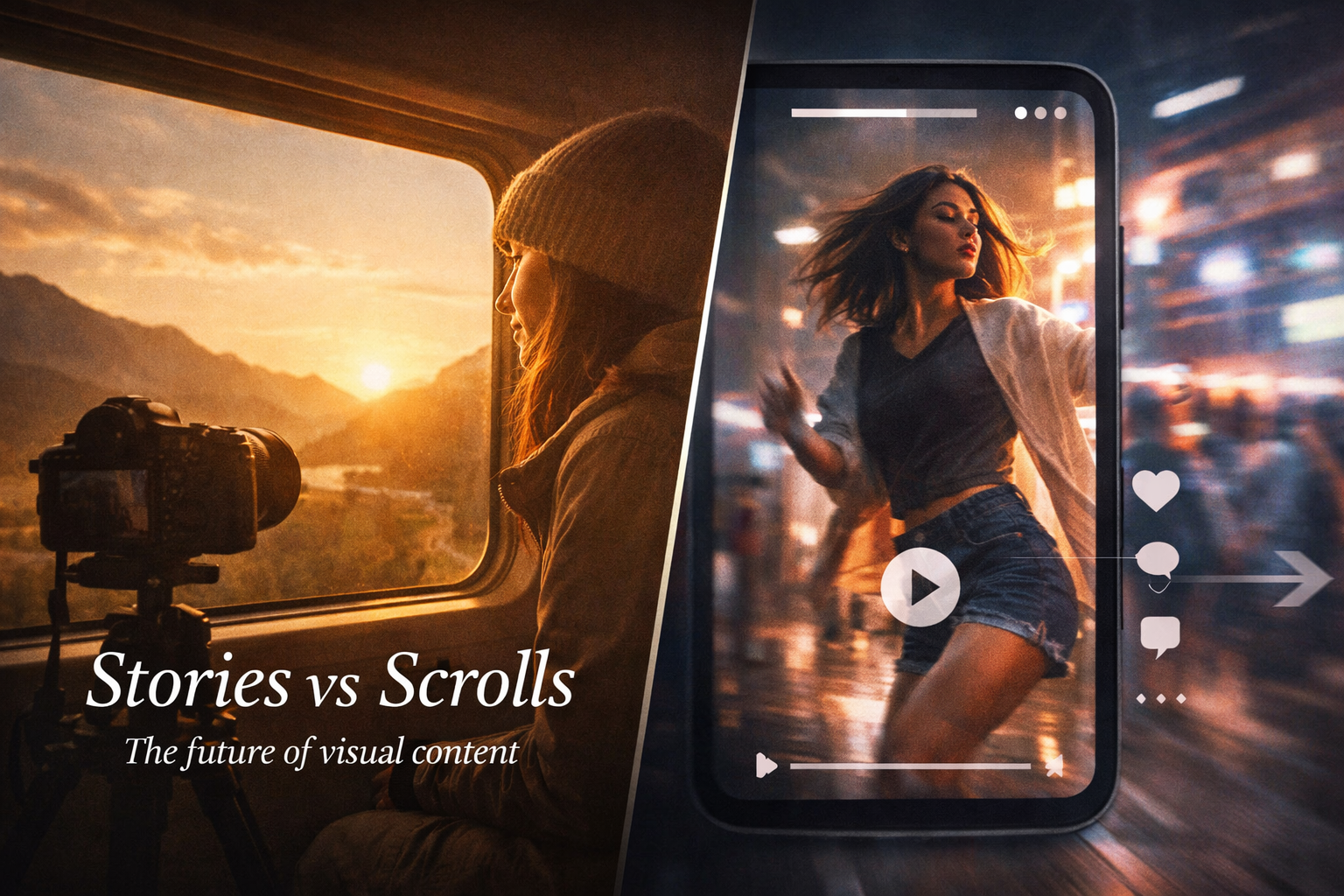

For years, storytelling was shaped by filmmakers, writers, and lived experiences. Today, it’s increasingly shaped by algorithms.
Hooks in the first two seconds, retention graphs, loop-friendly endings. Formats designed less for emotion and more for performance.
Short-form, algorithm-driven content has redefined how stories are consumed. But in doing so, it has also raised a critical question:
Is cinematic storytelling losing relevance or quietly evolving into something more powerful?
The Era of Algorithm-Driven Shorts
Algorithm-driven shorts didn’t dominate by accident. They solved a modern problem: shrinking attention spans.
Platforms rewarded content that was:
- Fast to understand,
- Easy to consume,
- Designed for instant reaction,
- Optimized for repetition.
For brands and creators, this felt liberating. You no longer needed large budgets, long timelines, or theatrical polish to reach massive audiences.
But there was a trade off.
- Stories became compressed.
- Emotion became accelerated
- Depth became optional.
What mattered most wasn’t what stayed with the viewer, but what stopped the scroll.
What Cinematic Storytelling Has Always Done Differently is “cinematic storytelling has never chased attention.” It has trusted emotion, Instead of hooks.
It relies on:
- Atmosphere
- Rhythm
- Silence
- Visual intention
Cinema doesn’t explain everything. It lets the viewer feel first and understand later.
Where short-form content aims for immediacy, cinematic storytelling aims for memory.
And memory (not virality) is what builds long-term brand value.
The Attention vs Memory Divide, this is where the real divide lies.
Algorithm-driven shorts:
- Maximize reach
- Increase frequency
- Deliver visibility
- Cinematic storytelling: Builds identity
- Creates emotional recall
- Develops trust
One drives numbers, the other drives belief.
The mistake many brands make is treating these formats as competitors, when in reality they serve entirely different roles in the storytelling ecosystem.
Why the “Either Or” Debate Is Outdated
The future of visual content isn’t cinematic versus short-form, it’s cinematic through short form. Audiences haven’t stopped caring about stories, they’ve just changed how they enter them. People might discover a brand through a 15-second reel, but they decide how they feel about it through deeper, more intentional storytelling.
The smartest brands are no longer asking:
“Should we make reels or films?”
They’re asking:
“How do our stories travel across formats without losing meaning?”
The Hybrid Future of Visual Storytelling.
What’s emerging now is a hybrid approach, one where cinematic thinking guides even the shortest pieces of content.
- Shorts With Cinematic Intent
The next generation of short-form content won’t be chaotic or trend-heavy.
It will be:
- Emotion-driven
- Visually intentional
- Focused on one idea, one mood, one moment
Not everything needs to go viral.
Some content just needs to resonate.
- Long-Form Films as Story Anchors :
Cinematic films are becoming narrative anchors rather than standalone assets.
A single long form film now:
- Defines brand identity
- Sets emotional tone
- Creates a story universe
Shorts, reels, and clips don’t replace the film. They extend it.
Each short becomes a doorway, not a summary.
3. Algorithms as Distribution Tools, Not Creative Directors
The most successful storytellers don’t ignore algorithms, but they don’t surrender to them either.
They understand:
- Where their audience lives
- How content travels
- What platforms reward
But they never let metrics decide the soul of the story.
Algorithms control distribution.
Storytellers control meaning.
What This Means for Brands & Tourism?
For travel, hospitality, and destination brands, this shift is especially important.
People don’t choose destinations based on trends.
They choose them based on emotion, imagination, and connection.
Cinematic storytelling:
- Builds desire
- Shapes perception
- Creates longing
Short-form storytelling:
- Maintains relevance
- Increases recall
- Keeps the brand present
The future strategy isn’t louder content, it’s layered storytelling.
What This Means for Filmmakers & Creators?
The creators who will thrive next aren’t the fastest editors or trend chasers.
They are:
- Observers
- Story architects
- Cultural translators
The most valuable skill in the coming years won’t be “how to go viral.”
It will be:
How to communicate something meaningful, even in 10 seconds.
So, What’s Next?
Cinematic storytelling isn’t fading. Algorithm driven shorts aren’t disappearing.
What’s happening is a reset.
A shift toward stories that:
- Respect attention
- Value emotion
- Adapt to modern formats without losing depth
The future belongs to storytellers who understand both cinema and context.
Because while algorithms may decide what gets seen,
stories still decide what gets remembered.
Closing Thought:
At RealityBox, we don’t see cinema and short forms as opposing forces.
We see them as different languages telling the same truth.
Stories don’t need to shout,
They need to stay.




No Comments